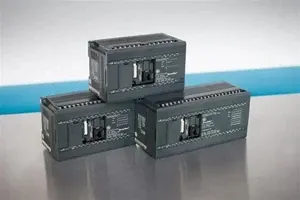
The RSTi-EP CPE200 series from Emerson sits at the boundary between compact and modular — it is a DIN-rail PAC that starts as small as a brick-style controller with embedded I/O and scales to a multi-rack system with distributed PROFINET drops. For machine builders deciding between the CPE100 (compact), CPE115 (compact with extended memory), and a full modular RX3i PAC, the choice hinges on I/O count trajectory, scan speed requirements, and whether the machine platform will spawn variants over its production life. This guide maps the scaling path.
CPE100 vs CPE115: when does the compact ceiling hit?
Both the CPE100 and CPE115 share the same RSTi-EP form factor — a DIN-rail-mountable CPU with onboard I/O and the ability to attach local RSTi-EP slice I/O modules directly to the CPU backplane. The CPE100 is the entry point: one Ethernet port, sufficient program memory for machines with roughly 100–200 I/O points, and a scan time adequate for general discrete control. The CPE115 steps up with more user memory, a second Ethernet port for device-level ring topologies, and OPC UA server capability — making it the right choice when the machine needs to report production data upward without a separate gateway. The practical ceiling for both: about 64 local I/O slices before you need to transition to a distributed architecture. If your machine's I/O count is growing at more than 10% per generation, start with the CPE115 even if today's machine fits within CPE100 limits — the memory and second port become essential by the second variant.
How does RSTi-EP distributed I/O change the scaling math?
Once local I/O on the CPU backplane hits its limit, the RSTi-EP platform shifts to distributed I/O over PROFINET. The CPU remains the I/O-Controller, and additional RSTi-EP slice stations — each with their own bus coupler — become I/O-Devices on the machine network. This is the architecture inflection point: the controller transitions from a self-contained brick to the head of a distributed system. Scan time now depends on the PROFINET send clock rather than the local backplane speed. The key advantage is that distributed I/O stations can be placed close to sensors and actuators — reducing wiring and enabling modular machine sections that ship as pre-tested subassemblies. A CPE115 with three distributed RSTi-EP stations can easily handle 500+ I/O points while maintaining a sub-10 ms scan cycle.
When does the application outgrow a compact PAC and require modular?
Three signals tell you it is time to move from a compact PAC to a full modular system like the RX3i:
- Redundancy requirement. The RSTi-EP CPE200 series does not support CPU redundancy. If the machine or process requires hot standby — common in continuous chemical processing or turbine control — the modular RX3i platform with redundancy CPL410 CPUs is the minimum viable architecture.
- Multi-discipline control. When the application spans discrete logic plus motion control plus process loops with advanced PID, the compact CPU's single-threaded scan becomes a bottleneck. Modular PACs dedicate separate processors for motion and process control.
- I/O count exceeding 1,000 points. Above this threshold, the engineering overhead of managing dozens of distributed stations outweighs the cost savings of a compact CPU. Backplane-based modular I/O with high-density cards becomes both cheaper per point and easier to maintain.
What is the migration path from CPE200 to RX3i?
Because both platforms run the same PACSystems runtime and share the PAC Machine Edition programming environment, migrating from a CPE200 compact PAC to an RX3i modular PAC preserves the application code. Tags, UDTs, and ladder/structured-text routines port directly. The RSTi-EP distributed I/O stations already on PROFINET remain as-is — the new RX3i CPU simply becomes their I/O-Controller. The migration cost is the RX3i CPU, backplane, and power supply; the field I/O investment is fully retained.
The Emerson RSTi-EP CPE100/CPE115 compact PAC starts at a DIN-rail footprint smaller than a typical power supply — with a migration path to full modular redundancy when the application demands it. Browse our compact PLC catalog for entry-level options and our PACs page for modular platforms.