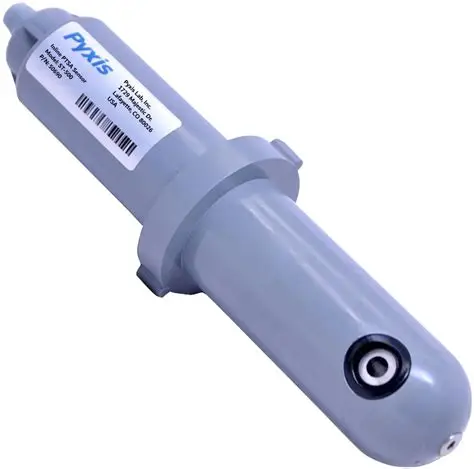
The Pyxis ST-500 Series is an inline fluorometer that measures PTSA (1,3,6,8-pyrenetetrasulfonic acid) tracer concentrations from 0 to 300 ppb for cooling water, boiler water, and closed-loop treatment monitoring. It outputs both a standard 4-20 mA analog signal and a Bluetooth wireless signal — giving you two paths to connect it to a controller, PLC, or mobile device. Which one you choose depends on whether you need a dedicated hardware controller on the wall or can work with a tablet and a wireless connection.
Two Ways to Connect the ST-500: Wired or Wireless
The Pyxis ST-500 inline fluorometer gives you two fundamentally different integration paths:
- 4-20 mA wired loop
- Connects to any process controller, PLC, or SCADA system with a standard analog input. The loop is self-powered (12–36 VDC), two-wire, and carries PTSA concentration as 4 mA = 0 ppb, 20 mA = 300 ppb. This is the path for permanent hardwired installations feeding a control room or plant DCS.
- Bluetooth wireless
- Connects to the Pyxis uPyxis mobile app (iOS/Android) or the SP-400 dual-channel controller via Bluetooth 4.0. Range is approximately 10 meters line-of-sight. This path is for field technicians calibrating the sensor, spot-checking readings, or running a wireless installation where pulling cable is impractical.
The two paths are not mutually exclusive. A common setup runs the 4-20 mA loop to the plant PLC for continuous monitoring while a technician connects via Bluetooth on a tablet for calibration and diagnostics — both active simultaneously.
Controller Option 1: Pyxis SP-400 Dual-Channel Fluorometer
The Pyxis SP-400 dual-channel controller is the most tightly integrated option for the ST-500. It accepts two Pyxis sensor inputs — typically one ST-500 for PTSA and a second Pyxis sensor for conductivity, pH, or a second fluorometer — and displays both readings on a single backlit screen. The SP-400 communicates with the ST-500 over the Pyxis sensor protocol and provides two 4-20 mA retransmission outputs plus two relay outputs for alarms or chemical dosing control.
The SP-400 + ST-500 combination is purpose-built for cooling tower chemical monitoring: PTSA tracer on one channel tracks inhibitor concentration, while conductivity on the second channel controls blowdown. A single controller, two parameters, both tied to the chemical treatment program.
Controller Option 2: GF Signet 9900 Single-Channel Transmitter
For sites already standardized on GF Signet panel instruments, the GF Signet 9900 single-channel transmitter accepts the ST-500 4-20 mA signal on its universal input, displays PTSA concentration on the LCD, and retransmits to the plant PLC. The 9900 adds two relay outputs configurable for high/low alarm or on/off control, a backlit display visible in direct sunlight, and a NEMA 4X front panel. Configuration is through the front-panel keypad — no laptop required.
Controller Option 3: GF Signet 9950-X Dual-Channel Chemical Controller
When the application needs both PTSA tracer monitoring and a second water parameter — typically free chlorine or pH — the GF Signet 9950-X two-channel controller reads the ST-500 on one 4-20 mA input and a chlorine or pH sensor on the second. Its dual relay outputs can independently control biocide dosing on one channel and corrosion inhibitor on the other, making it a compact chemical automation hub for cooling tower and boiler water treatment loops.
Controller Option 4: Any PLC or SCADA System with a 4-20 mA Input
The ST-500 is not locked into a proprietary controller. Because it outputs a standard 4-20 mA analog signal — not a digital protocol — it connects directly to any PLC analog input card, loop-powered indicator, or SCADA remote I/O module that accepts 4-20 mA. Wire exactly as you would any two-wire loop transmitter: PLC I+ to ST-500 +, ST-500 − to PLC I−, with 24 VDC loop power supplied by the PLC card or an external supply.
The trade-off is that a generic PLC input loses the PTSA-specific calibration curve, chemical dosing logic, and alarm presets that dedicated controllers like the SP-400 or 9950-X provide out of the box. You will need to build that logic yourself in ladder or structured text. For plants with an existing PLC programmer on staff, this is a non-issue. For plants without one, a dedicated controller is the lower-cost path to a working chemical automation loop.
Installing the ST-500: Key Setup Decisions
Before connecting any controller, the ST-500 itself must be installed correctly. It is an inline instrument — it mounts in a pipe Tee or bypass flow cell, not in an open tank. The sensor body is rated for 100 psi at 25°C (290 psi for the stainless steel flow cell variant), and the optical window must see a representative sample flow. Three decisions determine whether the installation works:
- Flow rate
- 200–1000 mL/min across the sensor window. Below 200 mL/min, bubbles accumulate and scatter the fluorometer beam; above 1000 mL/min, particle abrasion shortens window life.
- Bypass vs. in-line
- For process pressures above 100 psi, install the ST-500 in a side-stream bypass loop with a needle valve to drop the pressure. The sensor is rated for 100 psi at the optical window — exceed that and the O-ring seal leaks.
- Bluetooth zero calibration
- After physical installation, use the uPyxis app to zero the sensor against a PTSA-free water sample. Tap "Zero Calibration" in the app, wait 60 seconds, and confirm. Skip this step and every PTSA reading will be offset by the background fluorescence of your makeup water.
Which controller should I choose for cooling tower PTSA + conductivity?
The Pyxis SP-400. It reads both the ST-500 PTSA signal and a conductivity sensor natively — no external signal converters, no custom PLC scaling. Channel 1 reads PTSA (0–300 ppb) from the ST-500, channel 2 reads conductivity (0–15,000 µS/cm) from the SP-400 built-in input, and the two relay outputs independently control inhibitor dosing and blowdown. It is the shortest path from sensor to chemical automation in a cooling tower.
Can I monitor the ST-500 from my phone without a hardware controller?
Yes, for spot-checking and calibration. The uPyxis mobile app (free, iOS and Android) connects to the ST-500 via Bluetooth and displays real-time PTSA concentration, temperature, and sensor status. It also stores calibration history and exports data as CSV. But the app does not provide continuous monitoring, relay outputs for chemical dosing, or 4-20 mA retransmission to a BMS. It is a calibration and diagnostics tool — not a replacement for a process controller in an automated treatment loop.
Does the ST-500 work with the GF Signet 8900 multi-parameter controller?
The GF Signet 8900 accepts 4-20 mA inputs, so technically yes — but the 8900 is a multi-parameter fieldbus platform designed for Signet digital sensors and is oversized for a single PTSA fluorometer. The 9900 single-channel is a better fit: same display, same relay outputs, lower cost, and simpler setup. Use the 8900 only if you are already running it for other Signet sensors and have a spare 4-20 mA input module available.