
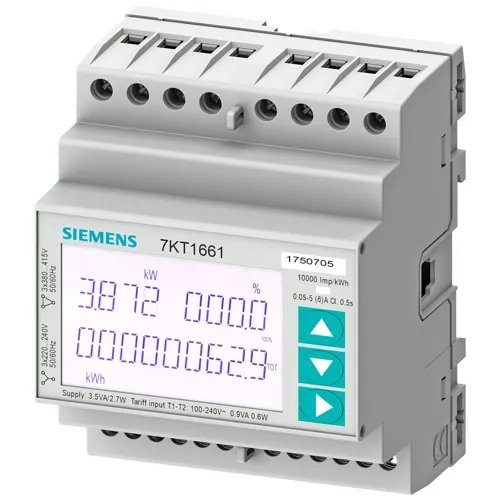
Product Specifications
- Brand
- Siemens
- Part Number
- 7KT1663
- Product Type
- 3-Phase Energy Meter
- Series
- SENTRON PAC1600
- Current Input
- 5 A (CT-connected, transformer-rated)
- Communication Interface
- M-Bus (EN 13757)
- MID Certification
- No
- Accuracy (Active Energy)
- Class 1 (IEC/EN 62053-21)
- Nominal Voltage
- 230 V L-N / 400 V L-L
- Frequency
- 50/60 Hz
- Dimensions (L × W × H)
- 90.6 × 72.3 × 63.2 mm
- Weight
- 332 g
- Mounting
- DIN Rail
Product Description
The Siemens 7KT1663 is the non-MID M-Bus variant of the PAC1600 series for CT-connected 5 A measurement. It brings M-Bus networked energy monitoring to installations where loads exceed 80 A and operational visibility is the goal — without the cost of MID billing certification.
When does the M-Bus + CT combination make sense without MID?
This combination fits three common scenarios: (1) Industrial facilities monitoring large loads through existing CTs where the network is already M-Bus based — the 7KT1663 drops into the existing infrastructure without paying for unneeded billing certification. (2) Data centres tracking energy usage by rack row or PDU segment through CTs, reporting to a DCIM system via M-Bus — operational data, not billing data. (3) University campuses and hospital estates with centralized BMS on M-Bus, metering individual buildings or departments for energy management and sustainability reporting — accountability without legal metrology.
How does CT sizing work with the 7KT1663?
Select current transformers with a /5 A secondary and a primary rating matching the maximum expected load. For a 400 A feeder, use 400/5 A CTs. The meter adds negligible burden (~0.3 VA) to the CT secondary. Since this is non-MID, there is more flexibility in CT selection — you can use existing CTs already installed in the switchgear if they have a /5 A secondary, even if they are not metering-class accuracy. The overall measurement accuracy will be limited by the CT class.
| Parameter | 7KT1663 (M-Bus, no MID) | 7KT1664 (M-Bus, MID) | 7KT1662 (Modbus, 5A, MID) |
|---|---|---|---|
| Current Input | 5 A (CT) | 5 A (CT) | 5 A (CT) |
| Communication | M-Bus | M-Bus | Modbus RTU/ASCII |
| MID Certified | No | Yes (Class B) | Yes (Class 0.5s + B) |
| Frequency | 50/60 Hz | 50 Hz only | 50 Hz only |
| Accuracy | Class 1 | Class 1 / Class B | Class 0.5s / Class B |
Frequently Asked Questions
What is the practical cable distance for M-Bus with the 7KT1663?
At the standard 2400 baud rate, M-Bus cable runs can reach several kilometres using standard telephone-grade twisted pair (JYStY 2×0.8 mm² or similar). The limiting factor is typically the voltage drop on the bus supply and the total cable capacitance, not the data signal itself. For very long runs or large numbers of meters, a higher-powered M-Bus master or repeaters may be required.
Can I convert an existing Modbus system to use M-Bus meters?
Modbus and M-Bus are different protocols at the physical and data link layers. You cannot directly connect an M-Bus meter to a Modbus RS-485 bus. However, protocol gateways that convert M-Bus to Modbus TCP or Modbus RTU are widely available from building automation suppliers, allowing M-Bus meters to feed data into a Modbus-based SCADA or BMS.
Related Products
- Siemens 7KT1670 — Direct 80 A connection with S0 pulse output for simple energy monitoring setups
- Siemens 7KT1668 — M-Bus interface with MID billing compliance for direct 80 A three-phase measurement
Resources & Documentation
Siemens 7KT1663 PAC1600 3-Phase Energy Meter — M-Bus Interface, 5A CT Input
Product Specifications
- Brand
- Siemens
- Part Number
- 7KT1663
- Product Type
- 3-Phase Energy Meter
- Series
- SENTRON PAC1600
- Current Input
- 5 A (CT-connected, transformer-rated)
- Communication Interface
- M-Bus (EN 13757)
- MID Certification
- No
- Accuracy (Active Energy)
- Class 1 (IEC/EN 62053-21)
- Nominal Voltage
- 230 V L-N / 400 V L-L
- Frequency
- 50/60 Hz
- Dimensions (L × W × H)
- 90.6 × 72.3 × 63.2 mm
- Weight
- 332 g
- Mounting
- DIN Rail
Resources & Documentation
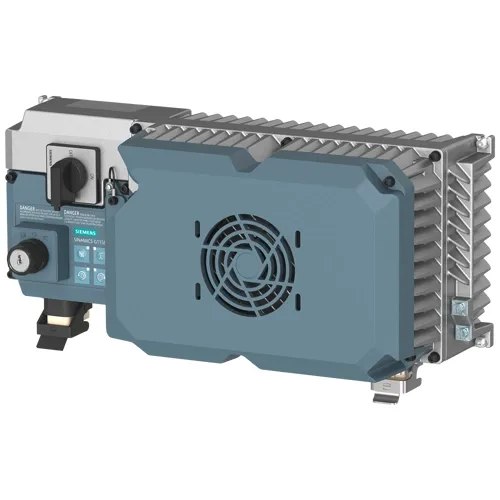
Siemens 6SL3520-1XA65-5AA0
5.5 kW Wall-Mounted Drive
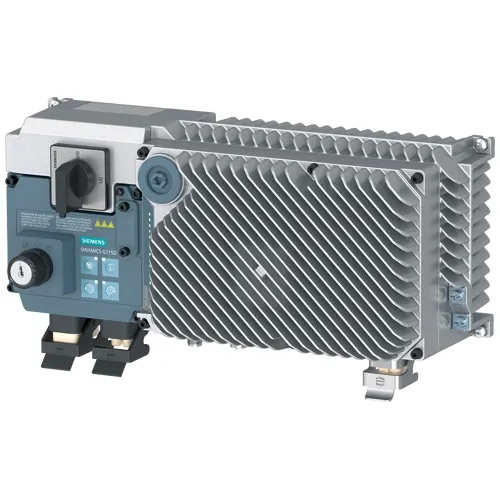
Siemens 6SL3520-2XA60-3AA0
0.37kW FSA Drive, I/O Control
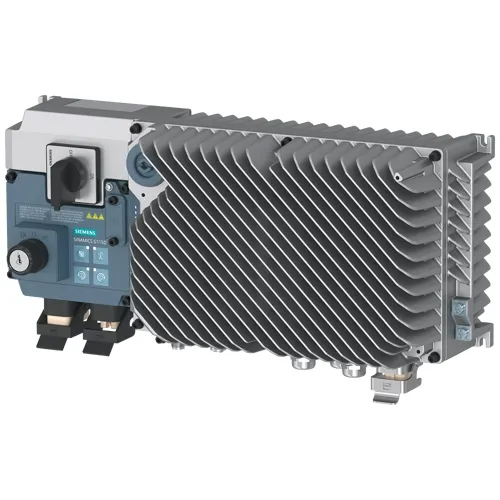
Siemens 6SL3520-2XE02-2AF0
G115D 2.2kW FSB Fanless PROFINET
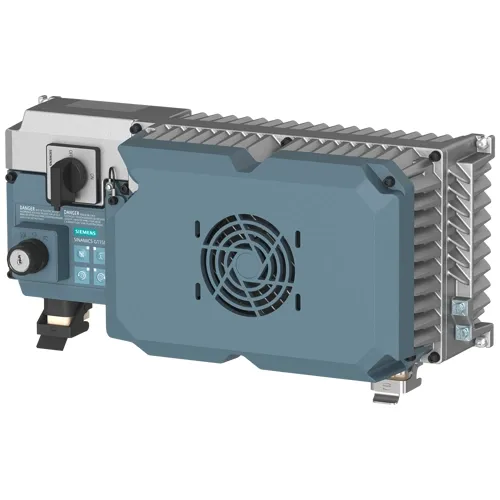
Siemens 6SL3520-2XH67-5AB0
SINAMICS G115D 7.5kW wall-mounted
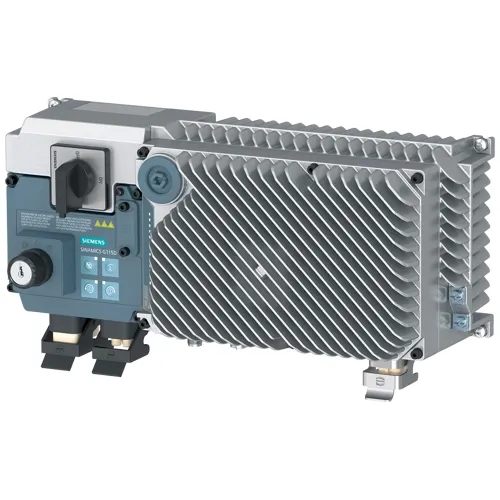
Siemens 6SL3520-0XB00-5AB0
0XB00 0.55 kW FSA, terminal I/O, SIMATIC
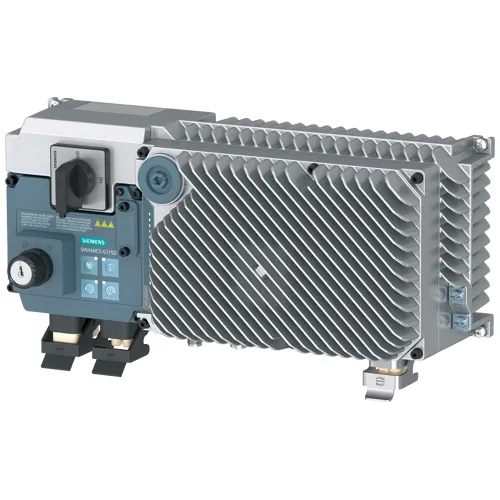
Siemens 6SL3520-0XE00-7AA0
0.75 kW Wall-Mounted Drive
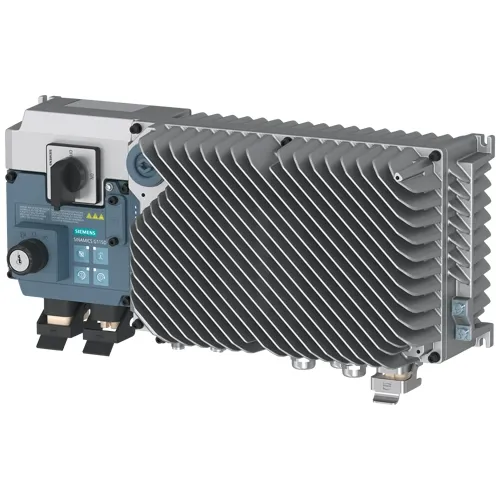
Siemens 6SL3520-0XE03-0AB0
3kW Fanless PROFINET G115D XE0x
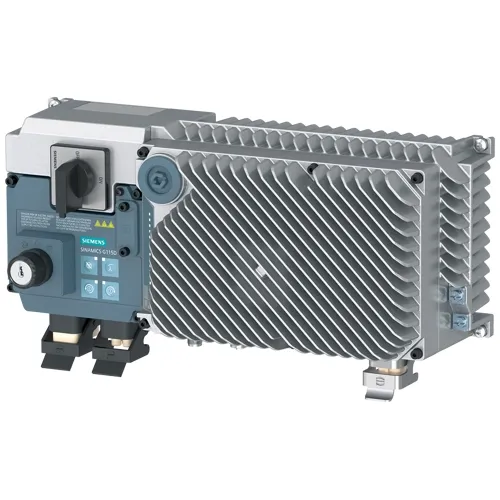
Siemens 6SL3520-2XE00-7AF0
0.75 kW PROFINET
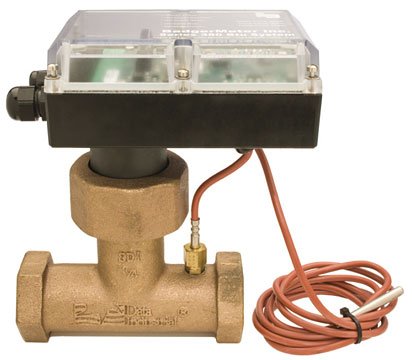
Badger Meter 380DS Series
Integrates flow and temperature sensors for energy measureme
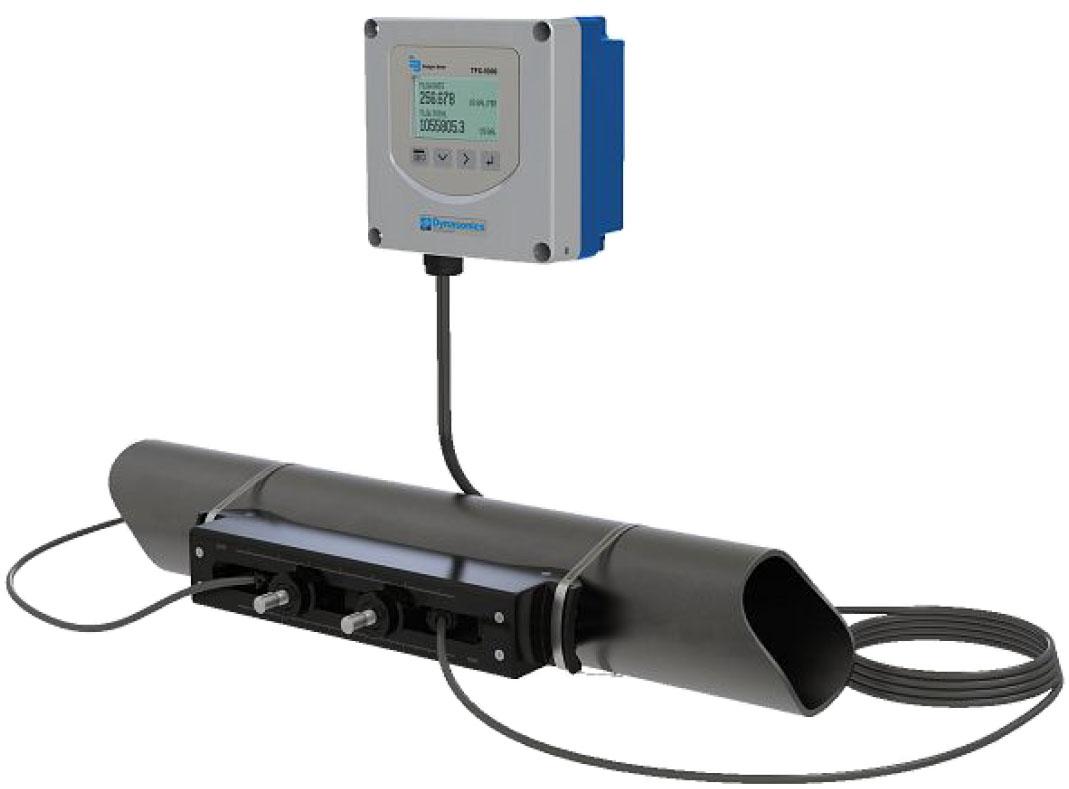
Dynasonics TFX-5000 Series
Non-invasive transit-time metering for clean and slightly dirty
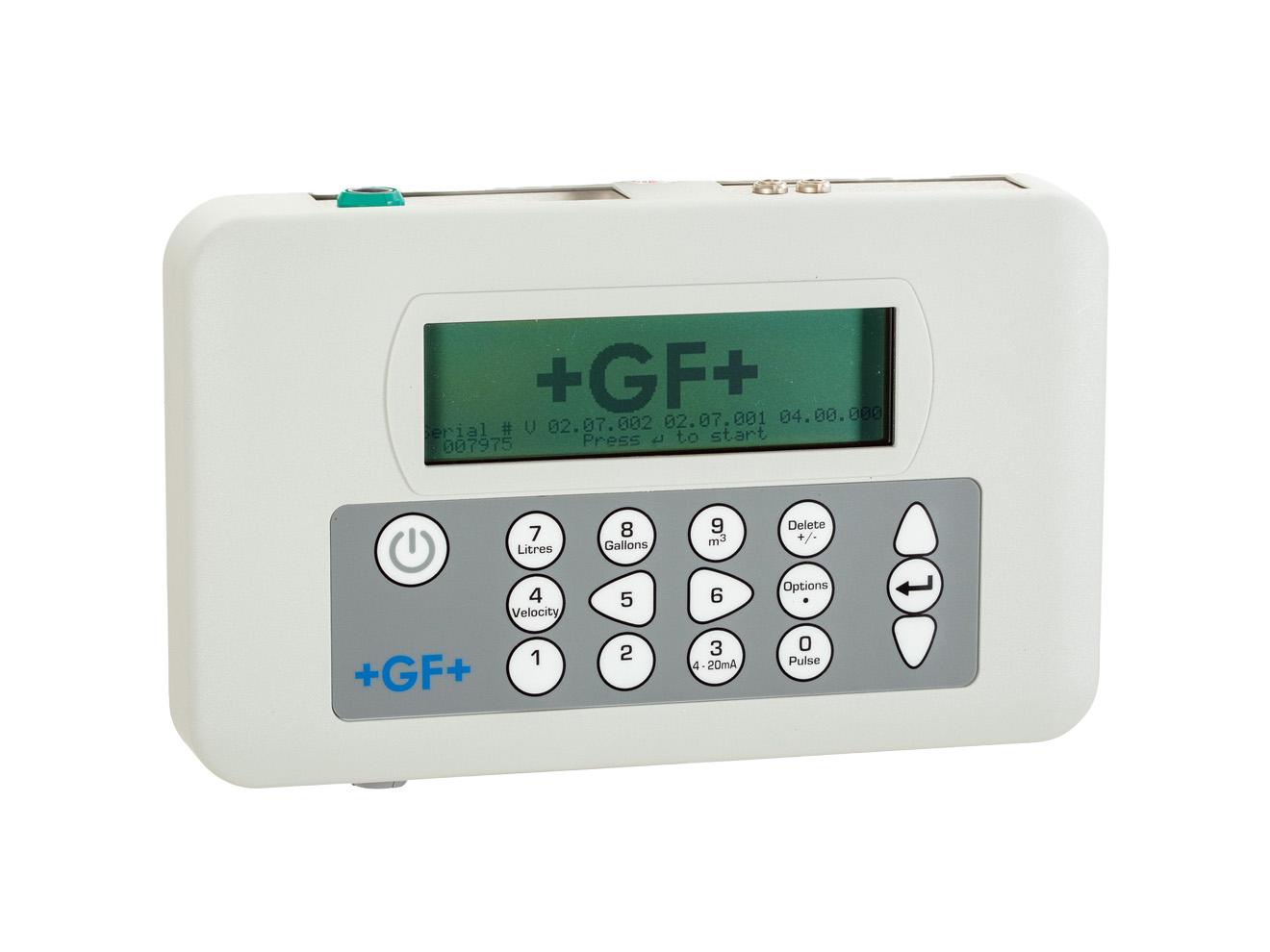
Georg Fischer / GF Signet Portaflow 220 / 330
Portable Ultrasonic Flowmeter, 0.1-20m/s
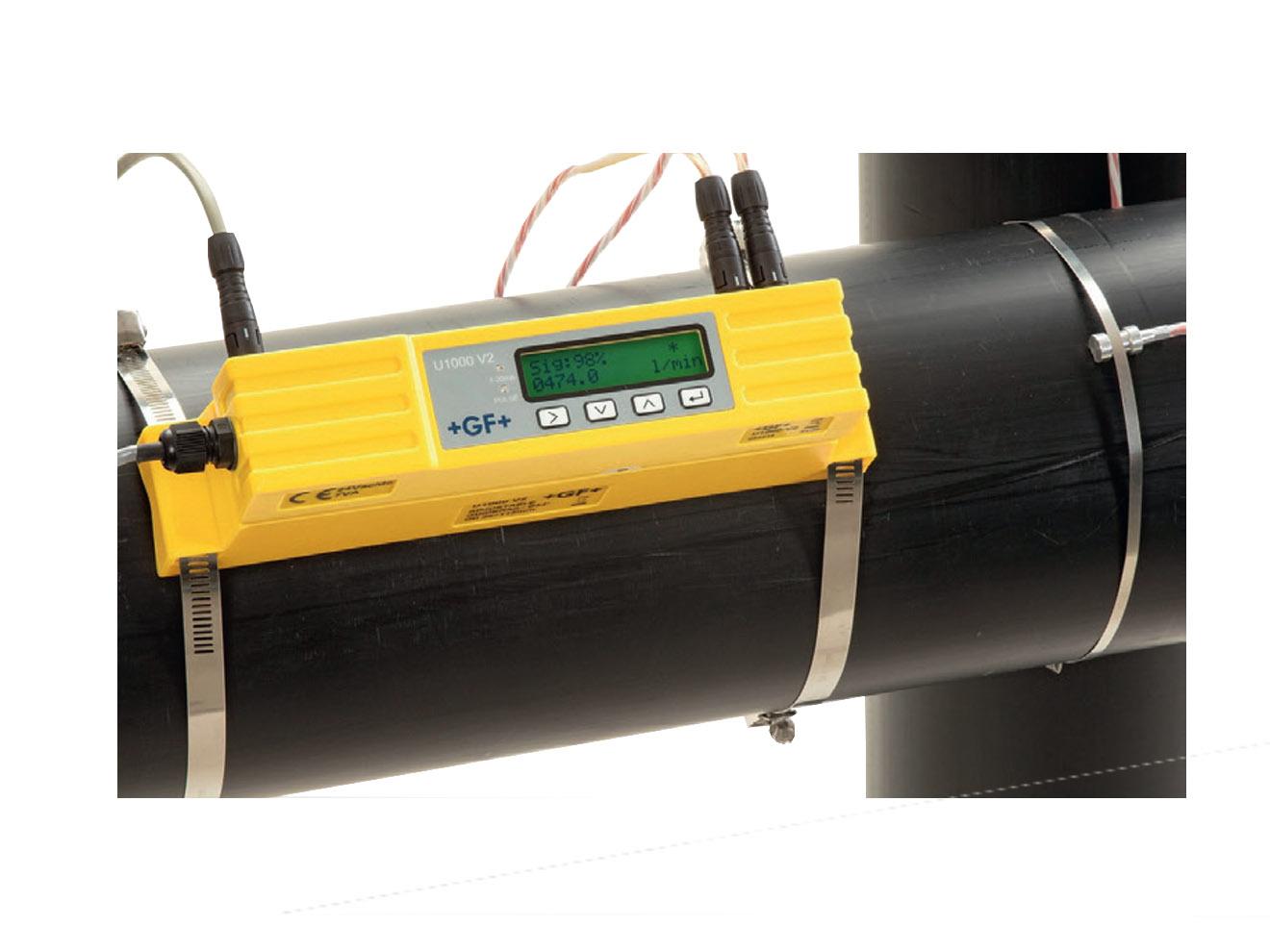
Georg Fischer / GF Signet U1000
Clamp-On Ultrasonic Heatmeter, 0.1-10m/s
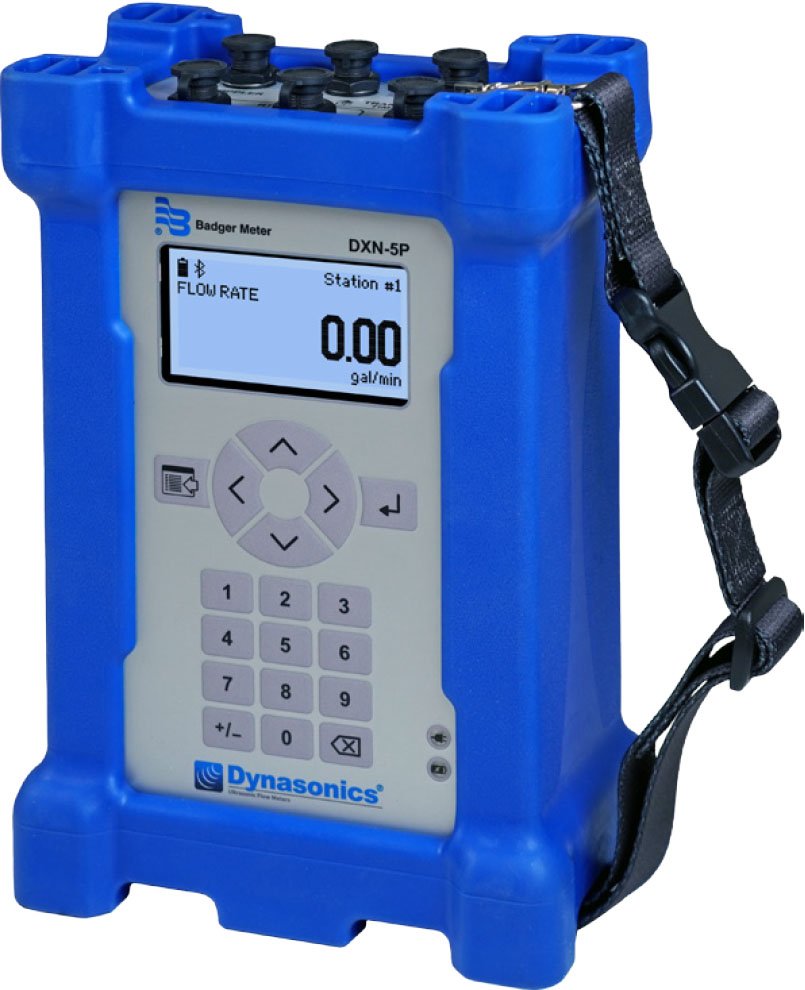
Dynasonics DXN-5P
Portable hybrid flow meter with energy monitoring
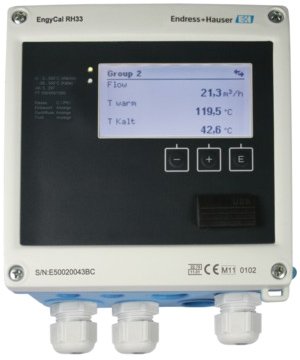
Endress+Hauser RH33
BTU Meter for Heating/Cooling, EN1434
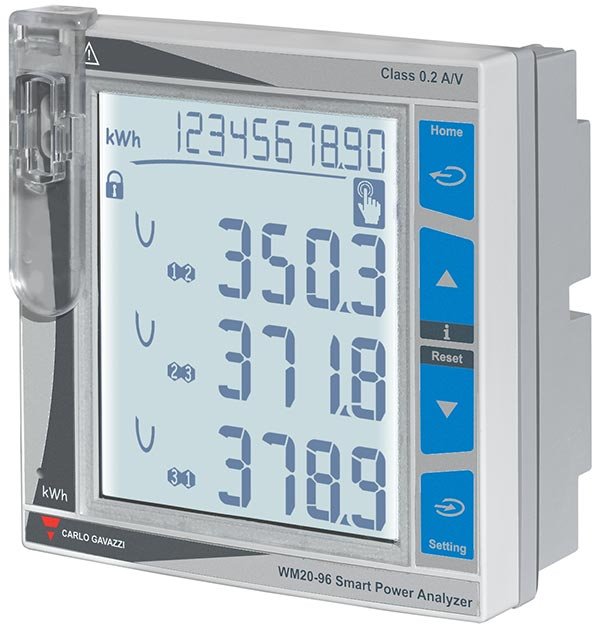
Carlo Gavazzi WM20AV53H
380-690V, 5(6)A, harmonics, dual alarms, LCD
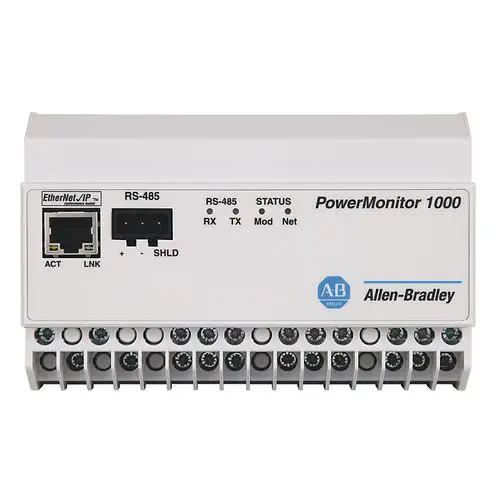
Allen-Bradley PowerMonitor™ 1000
Compact power meter with EtherNet/IP